
Tactus in Tokyo 2025
Tactus heads to Tokyo as Official Partners of the Tokyo 2025 Deaflympics
Music is a timeless and universal form of media; it’s an art form that transcends language and history. For this reason, it is a significant accomplishment that Jeremy Chow of Tactus has been able to translate music from audible to tactile, making it accessible to the Deaf community. Finding an alternative way for one of the most prevalent forms of art to be experienced is a uniquely abstract endeavour that Jeremy has been able to successfully undertake. Tactus is a technology startup that has been in operation since 2019. They specialize in active wear for individuals who are Deaf or hard of hearing. Their active wear allows Deaf people to experience music through vibrations synchronized to the rhythm of any song the user chooses. Jeremy Chow is the founder of Tactus, the recent winner of the Audience’s Choice Award at CIC Cambridge’s Demo Day held in June 2025, and whom I had the pleasure of interviewing for this article.
Activities in Tokyo
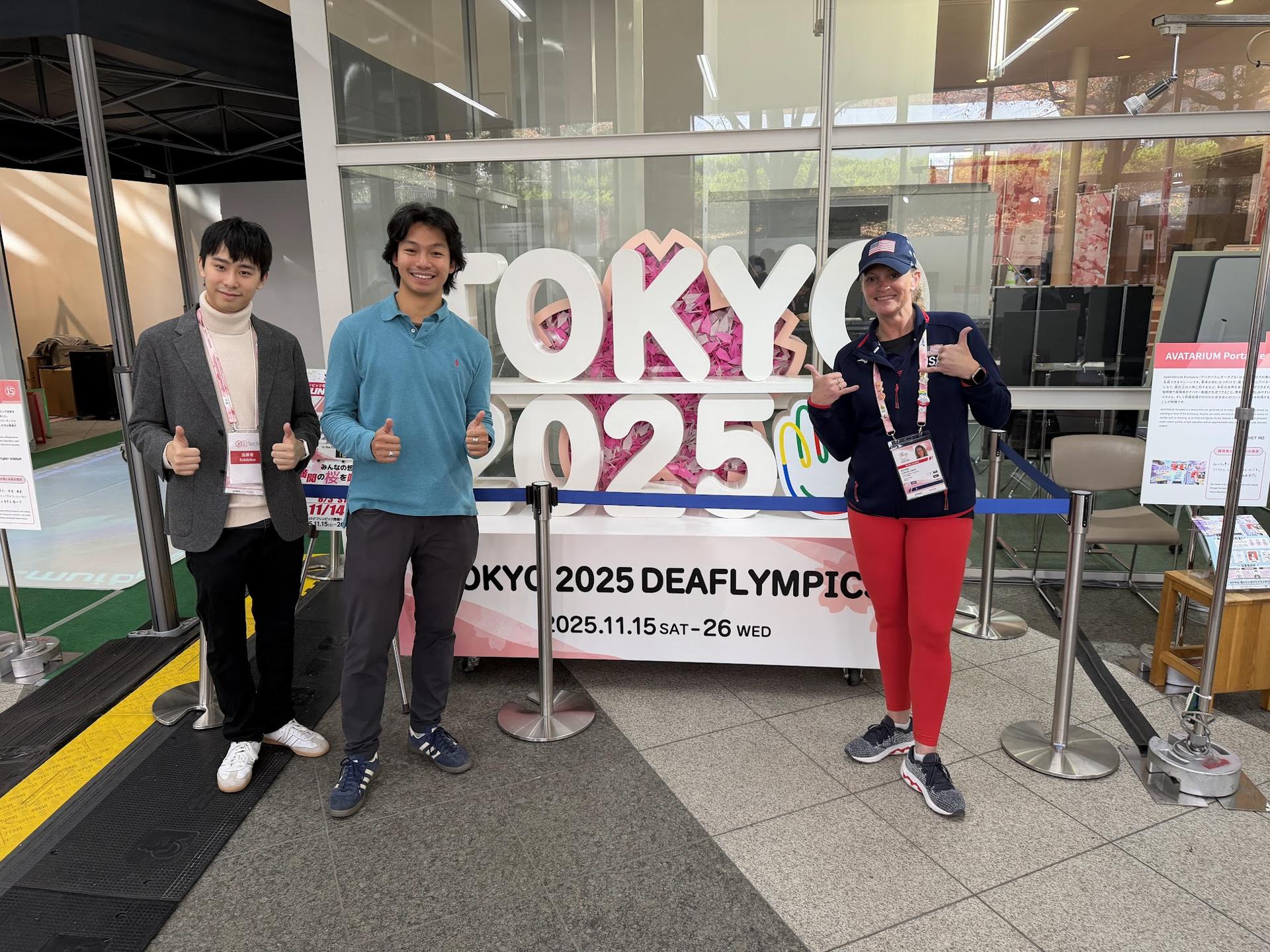
Despite being a company based in America, Tactus’s reach has had a significant impact overseas, and their goal of expanding the reach of their products through their Tokyo product showcase is evident. The duration of Tactus’s trip lasted from the 15th to the 27th of November 2025. During this time, Tactus participated in numerous high-profile events in Tokyo, firmly establishing their presence in Tokyo’s accessibility and innovation landscape. The events Tactus has participated in include the Miru Tech Exhibition, the Tokyo 2025 Deaflympics, and two collaboratively hosted speaking panels in partnership with Venture Cafe Tokyo at CIC Tokyo. With the help of these events, Tactus has been able to grow their audience and client base, as well as establish deeper personal accounts and relationships with the community they aim to serve. All of these connections were arranged through their partnership with the Tokyo Metropolitan Government, a connection facilitated by the CIC Cambridge Tokyo office, a coworking and innovation hub founded in Cambridge in 1999 that has since established locations globally.
Miru Tech
The Miru Tech Exhibition is a technology showcase specializing in universal communication, hosted by the Tokyo Metropolitan Government as an official addition to the Tokyo 2025 Deaflympics. At this event, Tactus set up a booth where attendees were able to experience the active wear firsthand with the assistance of Jeremy and my fellow classmates who volunteered.

The Deaflympics
The Deaflympics is an esteemed international multisport event held once every four years for Deaf athletes, organized by the International Committee of Sports for the Deaf (ICSD). First held in Paris, France, in 1924, the most recent Deaflympics in 2025 marks the event's 100th anniversary, as well as the first time the event has been held in Japan. At this most recent Deaflympics, Jeremy and his team presented their products at a booth available to both athletes and attendees. Tactus was also invited to participate in two live music events, which were not initially planned; the first of which was a part of the official Deaflympics programming, hosted by Tokyo Bunka Kaikan, a well-known cultural complex famous for hosting musical and theatrical performances. The second event was a live concert hosted by someone who had discovered their technology from the booth Tactus held at the Miru Tech exhibition.

Venture Cafe
Venture Cafe Tokyo is a non-profit organization that prioritizes creating innovative networking environments by connecting startups, investors, and corporations with similar ideals with events held throughout Tokyo. During Tactus’s stay in Japan, they held a product showcase in partnership with Venture. Unlike a typical product showcase, the audience contributed greatly to the content of the event, and was arranged more like a discussion panel centered on Deaf perspectives and lived experiences. During the panel, Jeremy was joined by a Deaf marketer and a Deaf dancer, where he contributed to the moderation of the discussion. During the event, the importance of accessibility and experiences unique to the Deaf and hard-of-hearing community were discussed.

Experience
Overall, Tactus’s trip to Tokyo was an affirming and enlightening experience. From Jeremy’s accounts, it’s clear that the time spent at all of these events has been a highly advantageous venture for both the company and their community. Seeing how impactful their products have been for the people who inspired their creation has been a moving, full-circle moment. From the meaningful connections Tactus has been able to foster and to the experience they’ve gained during their short stay, it’s apparent that they hope to do more work like this in the near future.
Interview with Jeremy:
As mentioned previously, I had the pleasure of interviewing Jeremy at the Miru Tech exhibition, held last November. He provided all of the insights that were able to help me construct this article. Below is a lightly edited transcript of an interview conducted with Jeremy on November 18, 2025.
Q: How long is Tactus staying in Tokyo for?
A: We'll be here throughout the Tokyo 2025 Deaflympics. It started on November 15th. I arrived a few days before just to help with setting up the exhibition, and we'll be exhibiting throughout the period of the event until the 27th of November.
Q: I hear Tactus is an official partner with the Tokyo Deaflympics. Is this Tactus’s first time attending the Deaflympics as an official partner? And is there anything you hope to do outside of showcasing your products?
A: This is our first-ever Deaflympics. I have not gotten a chance to see some of the games yet, just because they're a bit far away and I'm here spending a lot of time at the Miru Tech exhibition, but I hope to get some time to actually explore and see some of the games in the upcoming days.
Q: It seems like you have lots lined up for Tactus during your visit to Tokyo. What exactly do you have planned, and what does the timeline for all of these events look like?
A: We’re exhibiting on most days. This upcoming weekend, Miru Tech is hosting an event here officially with Deaflympics, which is a music-related event, and we've been invited to join that, as well as the rehearsal for that. That's over on Saturday and Sunday. And aside from that, I'll be meeting with some other people throughout. On Wednesday, I'll be meeting some of the inclusive sports groups. And then on Thursday, I'm hosting an event as well in Tonaromon Hills.
Q: How has Tokyo been for Tactus so far? Have you met anybody or spoken to any people or groups that you'd be interested in working with? A: Yeah, a lot actually. Yesterday, just while we were exhibiting here (Miru Tech), we met a lot of people within the Deaf community, people from different countries. And I actually got to spend some time with them yesterday evening, had dinner, and even went out afterwards to further hang out and socialize with them. So it was really interesting to be in that environment where it's a lot of, you know, mostly Deaf individuals using sign language. So I'm also learning a lot of sign language in that process.
Q: During some product showcases, I saw you using sign language earlier; you seemed very proficient. Do you already know sign language?
A: I actually don't. I would say I'm very much a beginner in sign language, but it's been great learning directly from the community and just learning in that environment as well. You know, I think with any language, really, you can really best learn when you fully immerse yourself in that environment.
Q: In the Q&A you had with CIC I believe they’re the ones who connected you with the Tokyo Metropolitan Government. What has it been like ever since you started partnering with them?
Yeah, that's been extremely helpful. We're part of CIC Cambridge. A co-working space and innovation hub that started in Cambridge in Boston, but they've grown globally and have an office here in Tokyo. So when I told them that I wanted to see how we can participate in the Tokyo Deaflympics, they got me introduced to some of the people working at CIC who have connections with the Tokyo Metropolitan Government. They’re the ones that actually got us into Miru Tech and allowed us to be partners of the Deaflympics to exhibit here. So that connection has been very, very valuable.
Q: Has Japan provided any new perspectives on Tactus's technology compared to the United States, or is the sentiment surrounding the technology you've developed generally the same?
A: Yeah, definitely some new perspectives. I think it's interesting to see how care is provided and how that's different between here and the U.S. In the U.S., there are Deaf schools. So a lot of the students there are Deaf, with teachers who are Deaf in this all-deaf environment. Whereas here in Japan, it's a lot more mixed, where students who are Deaf are also in classrooms with hearing students. So it's interesting to see that change and that difference between how that is handled between here and in the U.S. But overall, I see that Japan has a lot of priority and focus on accessibility. And so there's also that support given to companies who are developing these types of technologies, but also to individuals to give them the access to these types of technologies as well. We see that there are venues and organizations that provide that access, that partner up with companies that provide these solutions and technologies. So that has certainly been an interesting perspective. Another perspective that I've seen and kind of learned is that I think the price point we have it at is a bit high for the Japanese market compared to the U.S. market, just different purchasing power. So that's also an interesting perspective.
Q: I saw in one of your interviews that you mentioned you started playing guitar in middle school. It seems that you've always been very musically oriented. Have you always been interested in music? Or have you had any projects before Tactus that didn't relate to music?
A: Yeah. I've done projects in the past related to music. I've built my own speakers in the past and tried to build my own guitar and ukulele as well. I've always loved working with my hands and building things, and of course, building things in relation to music. I've also done music recording and mixing in the past, or working with artists as well, recording their music and producing their music. I'm not directly a part of the music creation part, but I also still get to provide the creative input to it, which I really enjoy. So long story short, I've always been really interested and passionate in music and wanted to combine that with engineering. So I'm really grateful to have found that, found a way to do that through this project and through this company. That is when I met Professor Lori Achin, who is the inspiration for what we're doing. She's a Deaf dancer and a choreographer. We built the first device for her through an engineering project, and that's what kick-started Tactus.
Q: Music is already a universally appreciated medium; you can enjoy it regardless of what language you speak, and because you're translating music in a manner that makes it even more universal. How do you find operating in a different country? Does it pose any unique challenges? Or is it easy due to the flexible nature of the medium you're using?
A: Yeah, that's a great question. I think music, in a way, is a universal language. So, a lot of people, despite what language they speak and where they're from, there's something they can relate to with music. That being said, it is a new technology, so when explaining the technology and explaining the product to someone from a different country, there are certainly language barriers to kind of give the full background story and the explanation. Luckily, when they do put it on and just experience it for themselves, a lot of them get it already, and so, you know, that's the universal language part. But some of the follow-up questions that they may have, like, “how much is it?” or “is it washable?” “Can I wear this while I'm running?” Things like that. Those are the kind of follow-up questions where we have a bit of challenges when we're operating and communicating with people from different countries around the world, which is something that we've seen a lot here with Deaflympics being such a global event, of course.
Q: After Tokyo, what do you have planned for Tactus next? Are you hoping to visit anywhere else? Or are you looking to return to build off what you've established during your trip so far?
A: Yeah, I'd love to return to Japan to continue building off the kind of momentum we've built here and the relationships that we've built. We'll actually be back in February because we have won our regional round of the pitch competition, and we'll be pitching again in Tokyo in February at a pitch competition. So we'll be back in Tokyo and hoping to, again, capitalize on some of the relationships and connections that we've built so far here. We're also going to be exhibiting in January at CES. It's one of the largest consumer electronics exhibitions in the world, and it's happening in Las Vegas in January. Very busy. Yeah, it's going to be a busy schedule, a lot of global events coming up, and yeah, certainly would still love to continue growing our business and growing our presence here in Japan.
The following two questions were asked in subsequent correspondence on January 20, 2026. In order to gain more insights after the events.
Q: About Deaflympics, considering it was your first time attending, how would you say it went? Did it meet your expectations? Was there anything you weren't anticipating?
A: I’m truly grateful for the opportunity to be part of the Deaflympics—especially as it was our first time attending. Being included in such a globally respected event was a major milestone for us, and it absolutely met and in many ways exceeded my expectations. One of the most meaningful aspects was engaging with Deaf individuals from around the world and being fully immersed in Deaf culture. Our work was very well received by both athletes and attendees who visited our booth, which was incredibly validating. One experience that I didn’t anticipate was being invited to participate in two live music events during the Deaflympics. The first was hosted by Tokyo Bunka Kaikan as part of the official Deaflympics programming. Some attendees requested to use our device so they could feel the music during a live performance in which their grandson was one of the performers. That moment was extremely special. They later shared that it was the best assistive technology they had used for live performances.
The second event was a live concert hosted by someone who had discovered our device at the Miru Tech booth. After experiencing it firsthand, he invited us to be part of a concert he was organizing. At that concert, a Deaf audience member attended with her hearing friend, and through the Tactus device, they were able to enjoy the beautiful music together. That moment strongly reflected our mission of creating shared and inclusive music experiences.
Overall, the Deaflympics was an incredibly positive and affirming experience, and I feel that it reinforced the impact of our work.
Q: How did the product showcase at Venture Cafe Tokyo go? How was the reception of your products? Did you receive any new insights?
A: The event at Venture Café Tokyo was not a traditional product showcase, but rather a panel discussion centered on Deaf perspectives and lived experiences. Aside from the live concerts, this was one of my favorite experiences during our Deaflympics trip. I was joined by a Deaf marketer and a Deaf dancer, and I had the honor of moderating the conversation.
During the panel, we discussed the importance of accessibility, the unique strengths and “superpowers” of the Deaf community, and how collaboration between Deaf and hearing communities can lead to meaningful impact. The turnout was incredible, with many Deaf individuals coming into the CIC space specifically for the event. The discussion was highly engaging and very well received by audience members—both Deaf and hearing.
One particularly meaningful takeaway was learning that the conversation had inspired a follow-up event focused on accessibility, which was later hosted at another Venture Café session. That outcome reinforced the value of creating spaces where Deaf voices are centered and heard, and it made the experience especially rewarding.